I built the life I was supposed to want.
Regenerative Life Architecture did not begin as a framework. It began with a company that closed, a body that stopped being ignored, and a fear I could not name at the time.
The life I built
I started my freight forwarding company at twenty-four and ran it for twelve years. Offices in Riga, then Minsk, then Moscow. A cargo consolidation service I opened from China to the Baltics. I made the decisions when things went wrong: the claims, the conflicts, the crisis negotiations.
My days were full of work, meetings, emails, calls, thinking, thinking, thinking. Non-stop. I think I was even thinking at night, in my sleep. I travelled constantly and it was genuinely exciting: new cities, new people, variety. But I never touched those places. No local culture, no exploration, no real connection. I arrived, I worked, I left.
I forgot about my body. No sport, apart from a skiing holiday once a year. I skipped breakfast, I skipped lunch. I was slim, but the slimness came from exhaustion, and I was fine with that. Targets and results mattered more.
I met a great many people. All of them through work. My relationships were bounded by my industry, my role, my status, and that seemed reasonable to me, because honestly, I had no energy left for anything else. When you are empty inside, you cannot share.
I thought building a successful business was my contribution.
Looking back, my business was my third child. It demanded far more of me than my real children did. For them there was a babysitter, then private tutors.
And I want to be clear about something, because it matters: I was happy for a long time, and I was proud. A self-made businesswoman. It worked. That is exactly what made it so hard to see.
The collapse
Then the market crashed, and sanctions reshaped everything the company stood on. I led my team through a long, hard period, and in 2016 I decided to close the company rather than let it slowly decline.
I did not choose to step back from that life. It ended, and I was left standing in it.
The empty days
My days emptied out. There was no office to rush to. My calendar thinned, and I found myself alone with myself.
Instead of the morning rush, I walked. Instead of a fast lunch in a canteen, I cooked. My body responded in two directions at once: the tension of deep stress finally surfacing, and underneath it, something beginning to loosen. Now that I was actually listening, it began to ask for things. Not just walking. Movement. I started going out in the evenings, seeing people, taking salsa classes. I spent time in nature.
Slowly I stopped thinking about my failure and started dreaming again. Not setting goals, not planning milestones. Just dreaming, the way you do as a child.
What I got wrong
After about six months of this, something turned. I wanted to contribute again. I wanted to use my skills, my experience.
Use. Not share. Not contribute. Use.
And underneath that word was a fear I could not name at the time: that I was drifting away from business, and that I would become obsolete. So I did what capable people do. I applied for a job, a good one, a well-known company in Riga, Logistics Department Manager.
I lasted six months.
It felt terrible. Unhuman. Against my body, against my rhythm, against my whole personality. Not because the company was bad, but because I had changed and I could not un-change.
It is like eating junk food your whole life without knowing what fresh food tastes like. You think it is normal, because you have never tried the other way. Then you eat well for a year, and you cannot go back, not because you decided not to, but because now you feel the effect immediately.
I was almost forty. My body sent the signals. This time, I heard them, and I chose to listen instead of overruling them.
What I actually changed
Here is the contradiction I had to resolve: I was afraid of becoming obsolete in business. And business, as I had lived it, was no longer a survivable environment for me.
Most people resolve that by picking a side. Grit your teeth and stay. Or renounce the ambition and leave.
I did neither. I did not fight my entrepreneurial character. I moved it into a field where it could run without eating me.
I trained as a teacher, a Cambridge certificate, teaching adults. What I actually learned there was a method: guided discovery. You don't tell people the answer. You build the conditions in which they find it themselves. That instinct became the spine of everything I've built since.
Then I founded Lonet.Academy, an online education platform, with competitive European startup funding. I still run it today. I still build. I still mentor people in business.
I changed the other environment too. In my forties I started again in a country that was not mine, no language, no network, no status, friends from zero. It was not a holiday. Learning to belong somewhere as an outsider, at that age, is slow and often humbling work.
I don't think the answer is to move abroad. Mine happened to. What mattered was that the environment I was living in kept rebuilding the old version of me every week: the same rooms, the same people, the same routines, and I finally changed it. For you it may be a room, a rhythm, a set of relationships. The scale is different. The operation is the same.
The entrepreneur survived. The environment changed. My ambition was never the disease. The soil was.
What I did not get back
My children were teenagers by then, and I began to enjoy time with them. It did not last long, they moved abroad to study, they had their own friends, their own lives.
I had to admit that I missed the moment. The moment they were children.
I cannot get that time back. I can still do something valuable with them now. Differently. Adjusting, adapting, finding the way. Both of those things are true, and I have stopped trying to make one cancel the other.
What is still unresolved
People ask what the method fixed in me. The honest answer is: nothing, because nothing was broken.
I am still a perfectionist. I am still quite self-critical. I used to think those were faults to correct. I don't any more. I stopped fighting my traits and started finding out where they belong: which environments, which work, which people let those same qualities do good instead of damage.
Nothing was removed. Everything was relocated.
That work doesn't finish, and it isn't meant to. It is why I measure, change something, and then measure again.
Why I teach this instead of just living it
Because I found my way by accident. It took a collapse, a wrong turn, and years I will not get back. Nobody handed me a method. I had to be broken open by a system I didn't control before I would listen to myself.
You should not need to lose everything to get yourself back.
That is what this is. The method I wish someone had given me at year ten, while everything still looked like it was working.
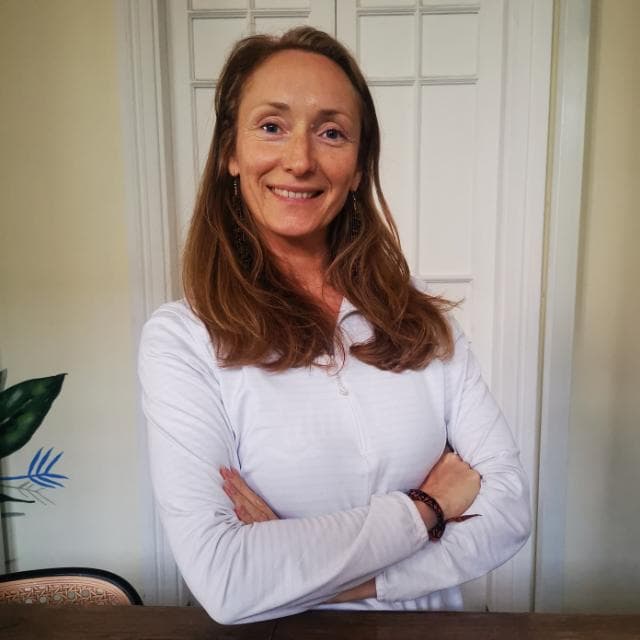
Kristine Baltaca is the founder of Regenerative Human Systems and the creator of Regenerative Life Architecture™. She ran an international freight company for twelve years, founded an online education platform that she still runs today, and still mentors people in business. Her method draws on positive psychology (University of Pennsylvania), systems thinking, and two decades of observing how people live and work across more than eighty countries.
Full background on LinkedIn →Not another wellbeing programme. A living architecture.
Conventional approaches
- Fixes applied to one part of your life
- Change that depends on motivation
- Wellbeing as something you do on the side
- Work on the person, leave the system untouched
- React to problems once they surface
Regenerative approach
- A structured method applied to the whole system
- Change built on evidence and observation
- Environments that regenerate you as you live in them
- Reshape the system, and the person follows
- See the patterns before they break something
Measurement without change is just a report. Change without measurement is just hope. This does both, and proves it worked.
No one can tell you exactly how to live, not a guru, not a book, not this programme. You are the only one who can find what truly works for you. So we do not hand you answers. We guide you to run your own experiments, try real changes, and observe what shifts, supported by assessment tools and tracking that show you what is actually working. You keep what works for you, and let go of what does not.
The method is ours. The answers are yours.
Six principles. All from nature.
Regenerative Life Architecture exists so that people can understand the systems that shape their days, and learn to tend them. Not to control everything, but to grow, on purpose, the parts of life that were left to chance.
Regeneration is not an event. It is a way of designing life.
Regenerative Life Architecture™, the six-module programme for people ready to understand their life as a living system and regenerate it.
Explore the journey →The same principles, translated for teams. For organisations →